Rabu, 29 Oktober 2014
How to Treat Your Dog's Dandruff: 7 Tips
Dandruff mostly occurs when the dog's skin cells naturally form, die, and flake off at a very fast rate. The following are seven suggestions on how to keep your dog's coat clean and dandruff free:
1. Because dandruff is a sign of flaky skin, you need to give your dog regular baths to wash away the flakes before they start to accumulate. Giving your dog a bath once a month during the winter season and twice a month in the summer time will help clear up the problem for good. Always use warm (not very hot) water to bathe your dog. Use a mild shampoo like regular baby shampoo and massage it thoroughly into his skin. Make sure that you rinse and dry well.
2. If using a regular baby shampoo does not get rid of the dandruff, try using a pet dandruff shampoo that contains sulfur or salicylic acid. Leave the lather on for about 5 minutes to give the active ingredients time to work. Medicated shampoos are available online and in pet stores. Do not use medicated shampoos intended for humans since they can be harmful to your dog. In addition, to prevent the dandruff from getting worse, do not use shampoos that contain insecticide such as most flea shampoos. These shampoos leave your dog's skin very dry, even those with added moisturizers.
3. You may use the same colloidal oatmeal soap that people use for dry skin to help relieve flaking. Oatmeal soap is great for dogs with dandruff because it moisturizes dry skin.
4. You can spray your dog's coat with an oil rinse, available online and in pet stores. Spraying him with an oil rinse helps lubricate the skin and lock in moisture. This is especially important if you live in a dry climate.
5. You can also rub your dog's coat with the same moisturizing lotion or cream that you use on your hands; this gets the moisture down really deep.
6. Regular grooming is also necessary in order to help distribute natural oils evenly over your pet's dry skin, which helps keep dandruff down. You need to choose a brush that is not too harsh. Test the softness of the brush by rubbing it on the back of your hand to see if it hurts. If it is soft enough to use on your own head, then it is going to feel good for your dog.
7. Some generic foods do not provide the full amount of vitamins and minerals that your dog needs in order to maintain a healthy skin. Switching to a high quality name brand food will help eliminate the problem. Sometimes, dandruff occurs because dogs are not getting enough fat in their diets. You need to consult with a vet before giving your dog any kind of supplement.

Selasa, 28 Oktober 2014
Nottingham City Police Dogs and Handlers
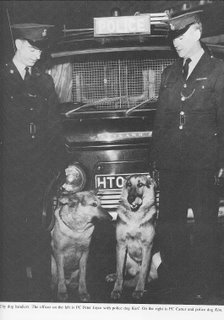
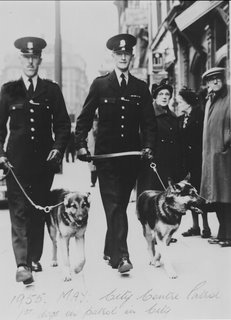 UK Police Dog History
Nottingham City Police Dogs
Beloved Companion and Therapy Dogs
By far the most common use of today's Labrador is as a home companion, a role at which he excels. Surprisingly, the Labrador Retriever was rarely kept strictly as a house pet until several decades after the breed's introduction to the united States. The initial fanciers of the breed became acquainted with him through knowledge of the shooting game. When the breed
was well established as a sporting companion, his docile, brainy nature won his way out of the kennel and into the home.
The Labrador Retriever's ability to quickly adapt and respond to instruction made the transition quite easy. Today, puppies raised in the home actually become so entwined in the lives of their owners that they often suffer when relegated to the kennel life. (If you are planning to keep a kennel of Labradors, select puppies that are properly socialized but still familiar with kennel life.)
As a companion, the Labrador Retriever is good-natured and gentle enough to accept the roughhousing of youngsters without returning it. If properly socialized while young, a Labrador will share his "home with another dog, providing there is enough affection for all. It is more common for a Labrador to misbehave out of jealousy than out of dislike for another animal.
Labrador Retrievers are long on self-control and loyalty, but they do not make the most avid watchdogs. As a rule, they are not overly suspicious of strangers or highly protective of loved ones, and when natural instincts are not stimulated they can be inattentive to such a task. Always keen for a scent or sound, a Labrador Retriever would certainly give voice at the approach of an intruder, but he might be won over by a friendly gesture or a luscious piece of sirloin. If left on duty, a Labrador Retriever may wander off in search of a scent that has caught his attention. In short, he is a people-dog. If you really need a watchdog, get your Labrador a German Shepherd friend!
The value of companionship with this breed should not be underestimated. In recent years, obedience-trained Labradors as well as other breeds are being used as Therapy Dogs to enrich the lives of nursing home residents and even emotionally disturbed children. The process is simple: a group of experienced dog handlers, such as those trained by Therapy Dogs International, bring their dogs to visit, perhaps put on an obedience performance for the audience, and then let animals and humans mingle, if conditions permit. The dogs are all obedience trained and have proven themselves to be extremely gentle and outgoing. Their job is to make people feel wanted, and it works wonders for alleviating the loneliness and depression that often burden such lives. Labradors love people and the few hours Therapy Dogs share with others enrich both dog and man.
Halloween Dog Walk for a good cause

A nice email just arrived from Heather Armstrong who helps to run the Gambia Horse and Donkey Trust (although it should really be the Gambia Horse, Donkey & Dog Trust as they look after a lot of dogs, too) saying that they hope to organise a national dog walk in aid of the charity on 31st October. She is looking for volunteers to help set up local walks and has designed some posters to help publicise each local event. Visit the Trusts website or email Heather (heather@gambiahorseanddonkey.org.uk) for more information.
Senin, 27 Oktober 2014
Weekend walks
I kept my promise this weekend and walked Sensi on both Saturday and Sunday — of course, not without a little drama.
My house is on a corner lot. Our driveway comes out to one road that borders us to the north, and private road runs along the front of our property to the west.
I chose to walk along the private road as the other road is a very narrow, twisting dirt road. In winter conditions, it’s plain ol’ unsafe to be walking down it when vehicles have a tough enough time without dodging walkers.
As soon as the weather breaks and the road improves though, I’ll be ditching my private-drive walks.
First off, the road isn’t long enough. Both Sensi and I were unphased by our walk, and we’re used to feeling a little winded by the time we return home.
Secondly, there’s a dog.
Near the end of the private drive, there’s a home on a hill with a long driveway. It’s on a curve, and after I had rounded the curve and continued on my way, I heard barks behind us. I looked over my shoulder but didn’t see anything. I made mental note to keep a lookout for dogs on my way back.
Sure enough, as Sensi and I were on our way back I spotted a big black lab barreling down the driveway, barking all the way. By the time it reached the end of its driveway, Sensi and I had just made it past. But the dog was still coming.
So I turned around and confronted it, positioning myself in front of Sensi and locking eyes to challenge the dog. The huge lab stopped dead in its tracks and stared back at me.
My heart was thumping as I tried to stay collected, knowing I couldn’t show the dog any fear. After a minute or so, he began looking away but wasn’t budging. I took advantage of his sign of submission to give a command.
“Get!” I growled at the dog, shooing him with my hand.
He turned around and started back up his driveway.
I waited a moment and then turned Sensi and I around too. As I looked over my shoulder though, the dog was coming toward us again.
I turned around again and faced off with the dog for a few more minutes. When he finally turned around again, Sensi and I were able to gain some ground before he started back after us.
He followed us for a while before stopping to pee on a tree and turning around to head home.
My heart pounded the whole way home.
On Sunday, my husband walked with me to help build my confidence.
Of course, we didn’t see the dog or any others.
I wish, oh how I wish, that people would just keep their dogs restrained to their yard.
ReadFull Article ..
My house is on a corner lot. Our driveway comes out to one road that borders us to the north, and private road runs along the front of our property to the west.
I chose to walk along the private road as the other road is a very narrow, twisting dirt road. In winter conditions, it’s plain ol’ unsafe to be walking down it when vehicles have a tough enough time without dodging walkers.
As soon as the weather breaks and the road improves though, I’ll be ditching my private-drive walks.
First off, the road isn’t long enough. Both Sensi and I were unphased by our walk, and we’re used to feeling a little winded by the time we return home.
Secondly, there’s a dog.
Near the end of the private drive, there’s a home on a hill with a long driveway. It’s on a curve, and after I had rounded the curve and continued on my way, I heard barks behind us. I looked over my shoulder but didn’t see anything. I made mental note to keep a lookout for dogs on my way back.
Sure enough, as Sensi and I were on our way back I spotted a big black lab barreling down the driveway, barking all the way. By the time it reached the end of its driveway, Sensi and I had just made it past. But the dog was still coming.
So I turned around and confronted it, positioning myself in front of Sensi and locking eyes to challenge the dog. The huge lab stopped dead in its tracks and stared back at me.
My heart was thumping as I tried to stay collected, knowing I couldn’t show the dog any fear. After a minute or so, he began looking away but wasn’t budging. I took advantage of his sign of submission to give a command.
“Get!” I growled at the dog, shooing him with my hand.
He turned around and started back up his driveway.
I waited a moment and then turned Sensi and I around too. As I looked over my shoulder though, the dog was coming toward us again.
I turned around again and faced off with the dog for a few more minutes. When he finally turned around again, Sensi and I were able to gain some ground before he started back after us.
He followed us for a while before stopping to pee on a tree and turning around to head home.
My heart pounded the whole way home.
On Sunday, my husband walked with me to help build my confidence.
Of course, we didn’t see the dog or any others.
I wish, oh how I wish, that people would just keep their dogs restrained to their yard.

Preservatives to Avoid in Dog Cat Food and Treats – Unsafe Toxic Carcinogenic…

In this article…
- Preservatives (used in pet food) that are seriously detrimental to your dog’s, cats health - negatively impacting your animals quality of life, and shortening life-span;
- Uses and dangerous side effects of these chemical-based preservatives.
1.0 Six Chemical-Based Preservatives You
Need to Get Out of Your Dogs Diet
- BHA;
- BHT;
- Ethoxyquin;
- Sodium Metabisulfite;
- Propyl Gallate;
- TBHQ
If you are feeding your dog or cat food or treats that include these preservatives – I recommend that you throw the product out and replace it ASAP with a product that is free of these chemicals…
The properties that make these six chemicals ‘good’ preservatives are also responsible for serious health issues in dogs and cats (other animals and humans!)
The seven preservatives noted above are chemical-based preservatives that can be found in many of the dog and cat foods and treats sold in…
- Veterinarian Offices;
- Pet Food Stores;
- Grocery Stores, and;
- Large Retail Stores such as Walmart.

These preservatives are added to ‘edible’ fats and fat-containing foods to prevent oxidative rancidity of fats and preserve odour, colour and flavour of a product.
These preservatives are very popular with Dog and Cat Food Companies as these chemical preservatives are: - Inexpensive, and;
- Readily available and thereby enable and support high profit margins.
Do pet food manufacturers have to use these chemical based preservatives?
No.
No.
But non-organic chemical-based preservatives are considerably cheaper than safe, healthy natural preservatives such as herbs (i.e. rosemary and sage), vitamins (i.e. vitamin E and C). Dehydration is also a way of naturally preserving food (i.e. pure, natural dehydrated chicken jerky), but dehydration reduces the volume of the product – so the manufacturer must either accept a lower profit margin or charge more for the product.
Chemical-based preservatives are of particular importance for companies that use rancid fats - for example pet food companies that purchase previously used fats from restaurants;
- These fats are cheap and readily available and although not allowed in human grade foods are allowed in pet food;
- This is also true for rancid meats etc. that cannot be used in human grade food, but are allowable in pet food;
- When the manufacturer adds chemical–based preservatives such as BHA, BHT etc.:
- The well-meaning, uninformed loving pet owner won’t smell how rotten the ingredients in the food really are, and;
- The loving pet owner has no idea that they are exposing their loved pet to a whole host of ailments and an early death.
In the mid 20th century (1950’s) the life-span of companion animals was twice what it is today…before the popularization of processed foods and associated food additives.

2.0 Uses and Dangerous Side Effects
BHA (Butylated Hydoxyanisole)
BHA is used as a preservative/stabilizer in:
BHA is used as a preservative/stabilizer in:
- Human and Pet Food;
- Packaging preservative, and;
- As a yeast de-foaming agent during food manufacturing.
Examples of Health Issues Caused/Triggered by BHA
- Adversely effects brain function;
- Adversely effects behaviour;
- Allergies;
- Cancer – Liver and Stomach
- Cell abnormality;
- Increased liver weight;
- As a toxin stored in fat BHA can definitely contribute to the formation of Fatty Tumors;
BHA is a bioaccumulative substance (absorbed by the body at a faster rate than it can be eliminated by the body) - as a result it contributes to ongoing toxic loading of the body.
BHT (Butylated Hydoxytoluene)
BHT is used as a preservative/stabilizer in:
- Human and Pet Food;
- Cosmetics;
- Electronic Transformers;
- Embalming Fluid;
- Packaging;
- Jet Fuel and other engine fuels and oils;
- Petroleum products;
- Pesticides;
- Pharmaceuticals;
- Rubber;
- Soaps and detergents.
BHT is a bioaccumulative substance (absorbed by the body at a faster rate than it can be eliminated by the body) - as a result it contributes to ongoing toxic loading of the body.
Examples of Health Issues Caused/Triggered by BHT
- Biochemical and/or cellular level change…
- Allergies;
- Endocrine (hormone) disrupter…
- Cancer – liver and kidney;
- Developmental toxicity;
- Fatty Tumors;
- Thyroid disrupter.
Ethoxyquin
The other preservatives discussed in this article – if present in a dog or cat food/treat WILL be listed in that food item’s ingredient list.
Ethoxyquin is different than the other preservatives as you will NOT SEE ethoxyquin listed on the ingredients;
The reason for this exclusion from the ingredient list is that ethoxyquin is not added directly to the food or treat;
- It is instead added to one of the ingredients in the food or treat product – specifically ethoxyquin is the preservative that is added to fish meal.
- While not all companies use fish meal that contains ethoxyquin – most do!
- Ethoxyquin is a lethel pesticide.
Ethoxyquin is an anti-oxidant used as a food preservative and a pesticide (called ‘Stop-Scald’). It is listed and identified as a hazardous chemical by OHSA. It has a rating of 3 on a scale of 1 to 6; with 6 indicating super-toxicity and requiring less than 7 drops to cause death. The containers that Ethoxyquin is stored and shipped in are marked with the word/symbol ‘POISON’. The US Department of Agriculture lists and controls Ethoxyquin as a pesticide.
Examples of Health Issues Caused/Triggered by Ethoxyquin
- Allergic reactions;
- Behaviour problems;
- Bladder cancer, it has also been shown to cause;
- Cancer of the kidneys;
- Deformity in puppies;
- Infertility;
- Organ failure;
- Significantly increases the chance of stomach tumors, and;
- Skin problems.
Ethoxyquin is a bioaccumulative substance (absorbed by the body at a faster rate than it can be eliminated by the body) - as a result it contributes to ongoing toxic loading of the body.
For more on Ethoxyquin – its use and dangers read here.
Sodium Metabisulfite
Is used as a preservative in:
- Human and Pet Food;
- Wine;
- Bleaching agent used in textile, pulp and paper manufacturing;
- Also used in chemical, film (movie and photographs), pharmaceutical industries and water/sewage treatment.
Examples of Health Issues Caused/Triggered by Sodium Metabisulfite
- Inhaled:
- Coughing, shortness of breath;
- Allergic, asthma-like reaction;
- Ingested:
- Abdominal pains;
- Diarrhea;
- Circulatory disturbance;
- Central nervous system depression;
- Nausea;
- Vomiting
- Sodium metabisulfite causes extreme allergic reactions in some sulfite-sensitive individuals (human, canine, feline) resulting in broncho-constriction, shortness of breath, wheezing, coughing, GIl disturbances, rapid swelling of the skin, flushing, tingling sensations and shock.
Propyl Gallate
Commonly used in combination with BHA and BHT in the following products:
- Human and Pet Food;
- Adhesives;
- Hair products;
- Lubricants;
- Gum and candy, etc.
Examples of Health Issues Caused/Triggered by Propyl Gallate
- Endocrine (hormone) disrupter…
- Cancer causing:
- Thyroid tumors;
- Brain tumors;
- Pancreatic tumors;
- Adrenal tumors;
- Prostate inflammation.
TBHQ (tertiary butylhydroquinone)
TBHQ is sometimes combined with BHT, but may also be used alone as a preservative in the following products;
- Human and Pet food;
- Cosmetics
- Skin care products;
- Lacquers, Resins and Varnish;
- Explosives.
Examples of Health Issues Caused/Triggered by TBHQ
- Asthama
- Cancer (stomach cancer);
- Cellular level change causing DNA damage;
- Collapse;
- Dellerium;
- Dermatitis;
- Endocrine disrupter;
- Hyperactivity;
- Nausea;
- Rhinitis;
- Restlessness;
- Tinnitus (ringing in the ears);
Vomitting
Legal Cruelty and Abuse
I must admit that I find it strange - we have laws to protect our companion animals from cruelty and abuse perpetrated by an individual, but we allow and pay pet food manufactures to slowly kill our pet companions.
An illogical situation if it were not for the human condition of greed - which then explains the reason for such extreme lack of ethics and morals as exhibited by the pet food industry.
Mankind is not.
Holistic Support
If you require additional support and guidance I would be pleased to assist you via my Holistic Diet, Nutrition Wellness Services:
- Unbiased Diet, Nutrition, Product Advice is available via this service
- Diet, Nutrition Wellness Plans are available via this service
Langganan:
Postingan (Atom)